
Mason jar wedding bouquets: how to arrange and set them up
Choose jars, estimate flower quantities, arrange a trial bouquet and plan transport, water checks and wedding-day placement.
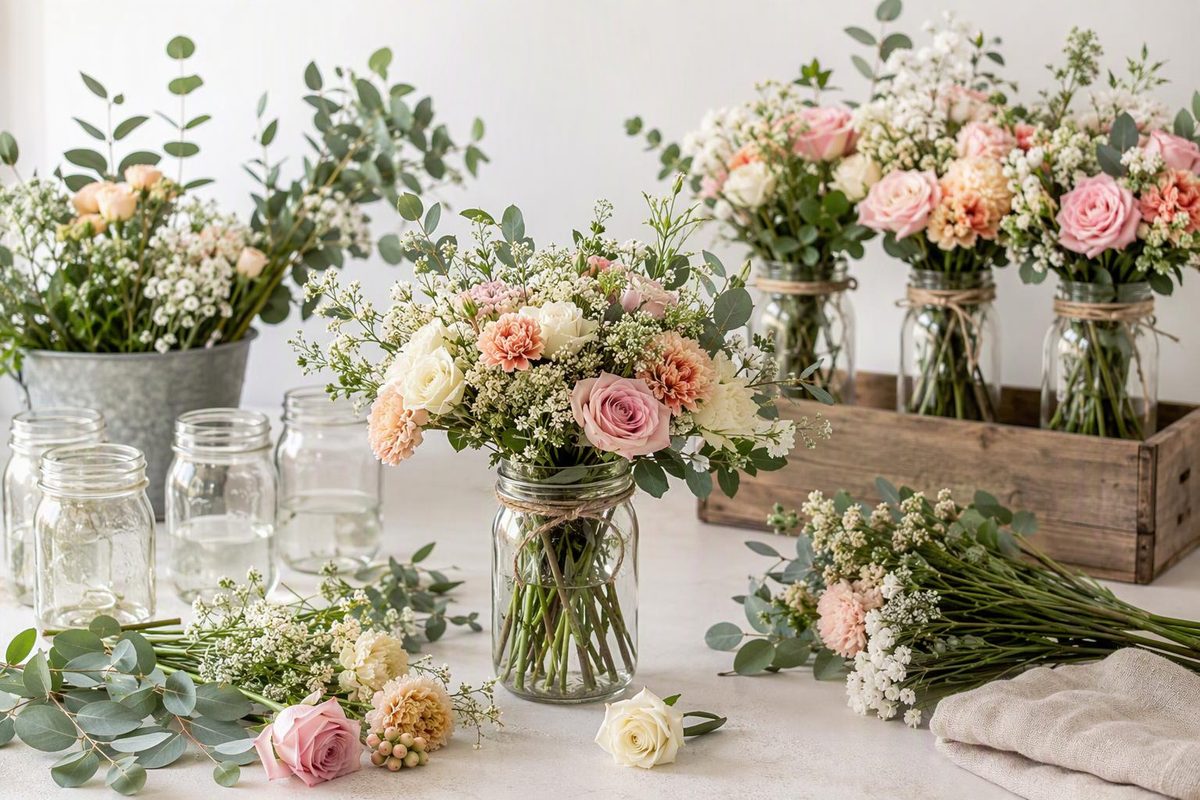
For mason jar wedding bouquets used as table flowers, choose the jar, make one trial arrangement, then multiply the recipe. The jar’s opening and the size of the flower heads matter more than a universal stem count.
If you mean a bouquet to carry down the aisle, make a separate hand-tied bouquet and use a jar as its water holder between photographs or events. This guide focuses on flowers arranged in jars for tables and other stationary displays.
Choose the jar before ordering flowers
Start with the actual jar you intend to use—not just a photograph of a similar one. Check its height, opening and footprint on a sample table with place settings, glasses and table numbers.
- Pint jars: a starting point for compact arrangements or small clusters.
- Quart jars: an option for fuller displays, but test the finished height from a seated guest’s viewpoint.
- Mixed jars: make a trial of each size rather than assuming one flower recipe will fit them all.
As an estimate, flower supplier Blooms By The Box recommends two greenery stems plus eight focal and filler flower stems for a pint jar, or four to five greenery stems plus 12–15 flower stems for a quart jar. Treat these as starting quantities, not guarantees: large blooms and branching stems fill space differently.
Before buying, confirm where the jars will go and whether the venue permits glass in those locations. For aisle flowers, agree on placement with the venue rather than setting jars where people need to walk.
Make one repeatable flower recipe
A suggested pint-jar trial is:
- Two stems of greenery
- Three roses as the main flowers
- Three carnations as secondary flowers
- Two stems of a branching filler flower
This is a design suggestion using the supplier’s starting stem count, not a tested recipe. Swap flowers to suit your palette and supplier’s availability, then check the result in your jar. A single flower type is also an option if you want fewer ingredients to sort and distribute.
Record the purchased stems used, including any branches you cut into smaller pieces. Blooms By The Box’s baby’s-breath guide demonstrates how one branching stem can yield several usable pieces; it also notes that its grower’s bunches are packed by weight rather than a strict stem count. Check your supplier’s pack contents before converting a recipe into an order.
Once the trial works, use:
Stems per jar × number of jars = base flower quantity.
For example, 12 jars using two greenery stems and eight flower stems each require 24 greenery stems and 96 flower stems before any allowance for damaged stems or extra displays. Decide that allowance with your supplier rather than assuming every delivered stem will be usable.
Prepare and arrange the flowers
Gather clean jars, clean buckets, sharp snips or secateurs, flower food, a measuring jug and a towel. Add ribbons or other exterior decorations before filling the jars so you are not handling them around finished flowers.
1. Clean and condition
Wash the jars thoroughly. Remove any leaves that would sit below the waterline, re-cut stems with a clean angled cut, and put them into clean water to hydrate.
The Royal Horticultural Society recommends conditioning prepared stems in a cool place for at least two to three hours, ideally overnight. Follow any flower-specific instructions from your supplier; receiving flowers and arranging them are not necessarily the same task.
2. Add water and build the shape
Use cut-flower food according to its label. The RHS recommends clean vases and flower food to help feed flowers and keep the water clean.
For a simple arrangement, try this sequence:
- Place the greenery first, angled in different directions to establish the outline.
- Add the main flowers, spaced around the jar rather than facing only one side.
- Add secondary and filler flowers where the arrangement needs colour or coverage.
- Turn the jar and inspect it from every side, including seated eye level.
Cut gradually. Hold each stem beside the jar before trimming, leaving enough length for its cut end to remain submerged. Use the trial’s finished height as a guide, but adjust individual stems instead of cutting everything identically.
If the jar looks crowded, remove a stem before buying more flowers. If flowers flop outward, try shorter stems or a narrower-necked jar in the next trial.
3. Check the finished arrangement
Make sure no foliage is underwater and every cut stem reaches the water. Keep finished jars in a cool place away from heat; the RHS also advises keeping cut flowers away from ripe fruit.
Do not promise yourself a fixed number of display days. Flower type, condition on arrival and storage conditions affect the schedule. Ask the supplier when your chosen flowers should arrive and be arranged.
Plan transport and setup before making every jar
Use the trial to rehearse packing as well as arranging. A suggested approach is to place jars upright in divided boxes or crates, with padding between the glass containers and enough clearance above the flower heads. Check that the jars cannot slide or tip during handling, and secure the boxes or crates in the vehicle; do not rely on loose jars balanced on a vehicle seat.
Name the person responsible for each job; one person may cover several:
- Packing: label boxes by table or display location.
- Transport: confirm the vehicle has room for the arrangements upright.
- Placement: use a table list showing how many jars belong at each location.
- Water check: bring a jug and towel and check stem coverage after placement.
- Collection: decide who removes the jars and where they go after the reception.
If flowers will move from the ceremony to the reception, name the person responsible and confirm the transfer window. Do not count the same jar in two places unless that move is feasible.
Before scaling up, time the trial—including cleaning, trimming, decorating and packing. If the full quantity exceeds the available help, workspace or cool storage, reduce the number of jars, simplify the recipe or ask a florist to handle part of the work. The useful saving is a manageable setup, not just a low container price.